
Bence Asztalos, Péter Szabó and Dávid Báll’s new joint album has been a hit internationally
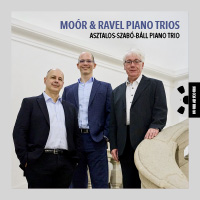
It is a pleasure to hear Dávid Báll (piano), and Péter Szabó (cello) performing together with Bence Asztalos (violin). I know Báll and Szabó from other recordings, but this is the first time I've heard them performtogether, and I'm very pleased to hear Asztalos for the first time as well.
This recording was made to celebrate the 250th anniversary of the Eszterházy Károly Catholic University (EKCU) in Eger, Hungary, where all three musicians are professors at the university's Music Institute. SinceBáll and Szabó have made several prior recordings for Hunnia Records, and Szabó is the principal cellist of the Budapest Festival Orchestra, coming to Hunnia's ProVibe Recording Studio on the outskirts of Budapest for this project made perfect sense. Add twenty or so fortunate listeners, and you have the makings of a very nice live musical event to capture.
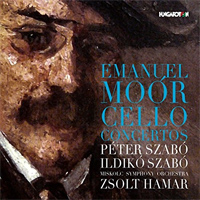
Emánuel Moór (1863–1931) is a composer whose music I've never encountered before. His Piano Trio in C major, his second piano trio, was probably written around 1908 and is very much attuned to the late-Romantic language of Brahms. It is an engaging work, and one that made me curious to hear more of Moór's music.
The other work on this album brings us to very familiar ground: Ravel's Piano Trio in A minor. One of the best-known chamber music works of the 20th century, it was written in 1914, at the outbreak of World War I, and completed it in just five weeks as Ravel prepared for military service. It received it's premier in Paris on January 28, 1915, and has remained a central work of the chamber repertoire ever since.
What makes this recording particularly interesting is the way the Asztalos-Szabo-Ball Piano Trio approaches both works. Their performances are direct, emphatic, and completely assured. That isn't to say they lacklyricism and emotion—quite the contrary. They simply don't mess about. They get right down to the business of conveying the music with authority and conviction.
On first listening, I was a bit set back in my seat. This wasn't quite what I expected. But the more I listened, the more I appreciated what the trio was doing. They strip away the excess and present the musical argumentwithout fuss: no nonsense, no fluff, and no excess prettiness.
With the Ravel, they speak with a different voice from what I hear in many of the numerous recordings of this familiar work—and I find that refreshing. There is plenty of color and lyricism, but the music neverbecomes self-consciously beautiful. The performance has an immediacy that keeps me engaged.
The Moór is treated in much the same way. I have no alternate recordings with which to compare it, but I don't feel that I need one to appreciate what these musicians have found in the work. Their directness allowsthe music itself to come forward, and the result has left me wanting to hear more of this composer who was previously unknown to me.
The live performance is captured beautifully by recording engineer Sándor Árok. Once again, he allows the instruments to breath, and their harmonics to fully develop within the relatively intimate acoustic theProVibe Studio. No, there isn't the air and openness of his location recordings in larger halls, but that is hardly a criticism. What he has captured here is intimate, immediate, and remarkably natural, with the dynamics, timbre, and detail of the three instruments realistically conveyed.
A composer new to me, a fresh perspective on a familiar masterpiece, and three superb musicians working together. And all in a lovely Pure DSD256 recording. That's a very satisfying combination.
Author: Jared Sacks
Source: https://positive-feedback.com/reviews/music-reviews/recent-finds-76-with-two-exceptional-recordings-from-jared-sacks/